
DAS AXOLOTL
The smiling ghost from the depths of Xochimilco
1/23/20262 min read
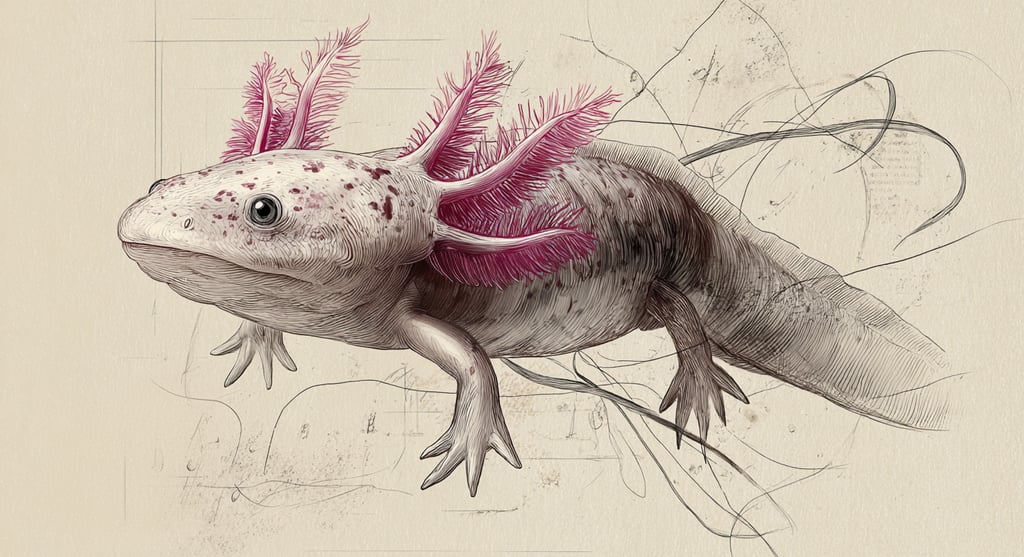
Axolotl – The smiling Spirit from the Depths of Xochimilco
Anyone who sees the axolotl usually falls in love with it immediately: A strangely charming creature with feather-like gills, beady eyes and a seemingly permanent smile. But behind this cute exterior lies a creature that is older than the Aztecs, as mysterious as a myth – and critically endangered.
A God in the Body of an Amphibian
The name ‘axolotl’ comes from Nahuatl, the language of the Aztecs. It is composed of atl (water) and xolotl – the name of a god who, in Aztec mythology, was considered the companion of the dead and the god of twins, fire and transformation. According to legend, Xolotl transformed himself into an axolotl to escape death. Ironic, considering that death – through human intervention – is once again hot on the animal's heels today.
A Miracle of Biology
The axolotl (Ambystoma mexicanum) is unique: it remains in the larval stage throughout its life – a phenomenon known as neoteny. It retains its gills even though it is fully grown and can still reproduce. It even regenerates lost limbs completely. No wonder, then, that it is attracting great interest in medical research.
A disappearing Home
In the wild, the axolotl lives exclusively in the lake system around Mexico City – particularly in the Xochimilco canal network, a last remnant of the once mighty Lake Texcoco. But it is precisely there that pollution, invasive species (such as tilapia), water extraction and urbanisation threaten the animal's survival.
The population has declined dramatically: while in the 1990s there were still around 1,500 animals per square kilometre, by 2014 there were fewer than 0.5 (BBC, 2014). According to a survey by the Universidad Nacional Autónoma de México (UNAM), the axolotl is considered critically endangered in the wild (IUCN Red List, 2023).
Between Myth and Future
Today, the axolotl lives mainly in laboratories and aquariums. It thrives in captivity – but what is a god without his kingdom? Numerous conservation projects in Mexico are attempting to clean up the canals, build artificial islands (chinampas) and revitalise the ecosystem. But it is a race against time.
The rediscovery of the cultural significance of the axolotl also plays a role: for many indigenous groups, it is not just an animal, but a symbol of resistance, transformation and rebirth.
Conclusion
The axolotl is more than just a curious amphibian star – it is a memorial to the fragility of ecosystems and a reminder that the boundaries between myth and reality are often blurred. Perhaps its connection to the god of transformation is a call to us: to repent, to protect, to change.
Quellen:
BBC News: Axolotl: The Mexican walking fish that can regenerate its body (2014)
https://www.bbc.com/news/magazine-25671303IUCN Red List: Ambystoma mexicanum (2023)
https://www.iucnredlist.org/species/1095/53947341National Geographic: Axolotl, der wandelbare Wasserdrache (2022, deutsch)
https://www.nationalgeographic.de/tiere/2022/03/axolotl-der-wandelbare-wasserdracheBritannica: Xolotl – Aztec Deity
https://www.britannica.com/topic/Xolotl